Artists can be inspired by the natural world and that includes animals such as birds. What a 'hoot' that there are some artists who mainly focussed on birds as the subject of their art. Let's look at art 'that's for the birds'. Jean Michel Basquiat Bird On Money, 1981

Maybe you'll make finger puppets or a drawing.
SUBJECT may be thought of as the "what" in a piece of art: the topic, focus, or image. The most common subjects of art include people (portraiture), arrangements of objects (still-life), the natural world (landscape), and abstractions (non-objective). Artist Juan Fontanive constructs ornithology flip books which constantly loop. Ornithology, deals with the study of birds
 each frame comes together to form a single bird in flight
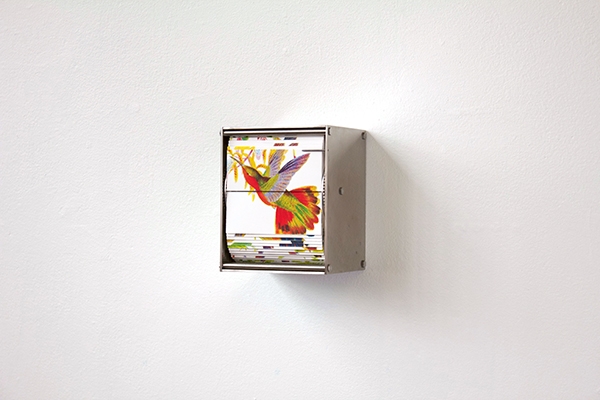 This art is Kinetic, it moves, it's in motion. How cool that you might make art that moves.


detail
Charley put his spin on birds, plants and animals. Charley had his own style of creating birds
 Once There Was a Field

Birdfeeders
Charley said, "When I look at a wildlife ... I see exciting shapes, color combinations, patterns, textures, ...endless possibilities for making interesting pictures."

Rainforest Birds
Charley grew up on a farm in West Virginia, spending time out in nature while avoiding the chores. Since his graduation from art school, he developed his own style of nature illustration often using printmaking to create his bird filled art.

Round Robin
Let's look at a few other artists who included birds as a SUBJECT in their art. Orchid and Hummingbird by Martin Johnson Heade 1885


Joseph Cornell was an amateur naturalist and bird-watcher. For Joseph, birds were a symbol of ....freedom, their flight path linking the sky and earth.

Joseph made a number of 'habitats' using natural materials collected on walks in the woods and fields. Have you ever collected materials in nature?
The box represents environments in museums. (Have you seen cases or boxes of objects in a museum?) Joseph Cornell created various collaged materials inside boxes. These 3D collages are called Assemblage

Constantin Brancusi’s Bird in Space. --some students thought this looked like a feather others saw a bird. What do you see?

Day and Night, 1938, by MC Escher.
MC Escher used both positive and negative space . The positive space is the pattern of white birds. If you look closely, you will see a pattern of black birds in the negative spaces between .
This Pueblo pottery also features birds in positive and negative space.

Pueblo pottery are ceramic (clay) objects made by the indigenous Pueblo people in the Southwestern United States and Northern Mexico
Molly Parks created this bird art. Molly is an outsider artist who comes from a family filled artists and musicians. An Outsider artist is self-taught and not really part of the art community.

*Will you create work inspired by our feathered friends?
*What other animals can be the subject of your art?
*Will creating an assemblage, a 3D collage, be the best way to express your idea?
Your Turn

Perhaps you'll make a collage inspired by Clare Youngs . Create patterned papers and collage them into possibly a chicken, rooster or duck.


detail
John James Audubon (April 26, 1785 – January 27, 1851) was a French-American ornithologist, naturalist, hunter, and painter.
 |  |
Carolina Parrot
He painted, described and put art images of life-size birds in catalogues (books) --the birds of North America. These books are still referenced today

Mourning Dove
Like Audubon, Charley Harper did field work, gathered information in the real natural environment and studied birds.
Mourning Dove
Like Audubon, Charley Harper did field work, gathered information in the real natural environment and studied birds.
 |  |
Charley put his spin on birds, plants and animals. Charley had his own style of creating birds
Once There Was a FieldThese birds are less realistic, more simplified and abstracted. You may notice lots of shapes make the flowers, insects and birds.
Birdfeeders
Charley said, "When I look at a wildlife ... I see exciting shapes, color combinations, patterns, textures, ...endless possibilities for making interesting pictures."
Rainforest Birds
Charley grew up on a farm in West Virginia, spending time out in nature while avoiding the chores. Since his graduation from art school, he developed his own style of nature illustration often using printmaking to create his bird filled art.
Round Robin
Let's look at a few other artists who included birds as a SUBJECT in their art.
The Little Owl is a watercolor on paper by Albrecht Durer from 1508, over 500 years ago.
Joseph Cornell was an amateur naturalist and bird-watcher. For Joseph, birds were a symbol of ....freedom, their flight path linking the sky and earth.
Joseph made a number of 'habitats' using natural materials collected on walks in the woods and fields. Have you ever collected materials in nature?
The box represents environments in museums. (Have you seen cases or boxes of objects in a museum?) Joseph Cornell created various collaged materials inside boxes. These 3D collages are called Assemblage
Constantin Brancusi’s Bird in Space. --some students thought this looked like a feather others saw a bird. What do you see?
 |
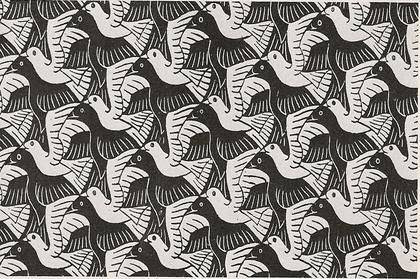
Day and Night, 1938, by MC Escher.
MC Escher used both positive and negative space . The positive space is the pattern of white birds. If you look closely, you will see a pattern of black birds in the negative spaces between .
This Pueblo pottery also features birds in positive and negative space.

Pueblo pottery are ceramic (clay) objects made by the indigenous Pueblo people in the Southwestern United States and Northern Mexico
 |  |
Forgotten Song by Michael Thomas Hill is an installation in an alley between two buildings. How is this an artwork about birds?
*What other animals can be the subject of your art?
*Will creating an assemblage, a 3D collage, be the best way to express your idea?
*Will you observe birds in nature?
Your Turn
Perhaps you'll make a collage inspired by Clare Youngs . Create patterned papers and collage them into possibly a chicken, rooster or duck.
 |  |
Accordion fold a sheet of paper to create wings. Cut out a bird body and a slit for the wings to attach.
 |
 |
Cut out cardboard shapes you would see on a bird. Attach and add embellishments such as drawn patterns, feathers, sequins, eyes.
Maybe you'll make finger puppets or a drawing.
|
|
 |

 |
 |
Sources:
https://artprojectsforkids.org/little-birdies-watercolor-painting/
http://theartroomplant.blogspot.com/2013/02/holly-parks.html
https://iheartcraftythings.com/paper-bird-craft.html
http://marymaking.blogspot.com/2016/06/recycled-cardboard-birds.html
https://www.artcampla.com/new-blog/8-women-artist-inspired-projectshttps://www.diys.com/paper-birds-tutorial/
https://www.atlasobscura.com/articles/photograph-birds-in-flight?utm_medium=atlas-page&utm_source=facebook&fbclid=IwAR2HvG0xj61QTFEPcDsOWu_6fRZas78opUK5CHGqBbpuLPjJNdl79_V5VqU
Notes/ to-do:
*thomas colesite flip birds
*thomas colesite flip birds
*bring in audubon prints
*laminate audubon or bird images to draw
*laminate audubon or bird images to draw