Today you will learn about the Clay Studio! We will go over expectations for Set up, Clean up and Studio Time.
What is Clay
Clay is a type of fine-grained natural soil material containing clay minerals. Clays become soft when wet but becomes brittle when dry and hard after firing. It's an art material that comes from the EARTH.
Let's look at how artists work with Clay and learn some Ceramic hand building techniques and process. When you work with clay using your hands it is called Hand Building.
Slab
Roll out clay and cut into shapes. You can cut a Slab. Make marks and texture into the surface. And press and shape the slab into a form.
Use a mold to create a form
Don't make the slab too thin or too thick
Here are a few more examples of SLAB projects
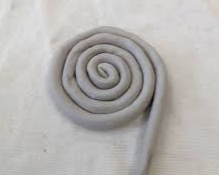
Coil
a long pliable cylinder/roll of clay.
You can get very creative with the way you roll coils into arches, spirals, donuts, twists and braids. You can cut coils into long and short lengths and place the horizontally and vertically.
Coils can be simple or intricate
Some artists like the coils to be visible or be part of their design. Other artists like to smooth away out the coil texture.
Pinch Pot
Pinching is a basic pottery technique, Making a pinch-pot is pressing the thumb into a ball of clay, and drawing the clay out into a pot by repeatedly squeezing and pressing the clay between the thumb and fingers
How about Attaching feet or a handle. Make a lid
Turn that pinch pot upside down--think of the possibilities!
What if you add coils and texture to your pinch pot
Slip and Score
Don't SKIP THE SLIP
Could you combine a COIL, PINCH POT and a SLAB?
Think of SLIP like your CLAY GLUE
Do you notice a clay coil attached to a pinch pot?
Texture
Using tools and materials to press markings into the clay surface.
Drying
clay must dry and be fired to become hard and waterproof. Once fired, water will not soften the clay.
Firing
a KILN is an oven for baking/ firing pottery. It gets hotter than your oven at home.
Things BREAK!
If your clay is too thin or too thick it can break. Slip and Score to make sure attachments stay in place.
Accidents can happen...but lessen the chance of accidents by paying attention and not playing around.
Glazing
Adding color to your fired clay often includes glaze although other materials can be used. Glaze can can be used to color, decorate or waterproof an item.
You will apply glaze like paint. Brush on 2 coats. Same color, same place, twice.
NO glaze the bottom of your work. if you get a little drop wipe off with a sponge.
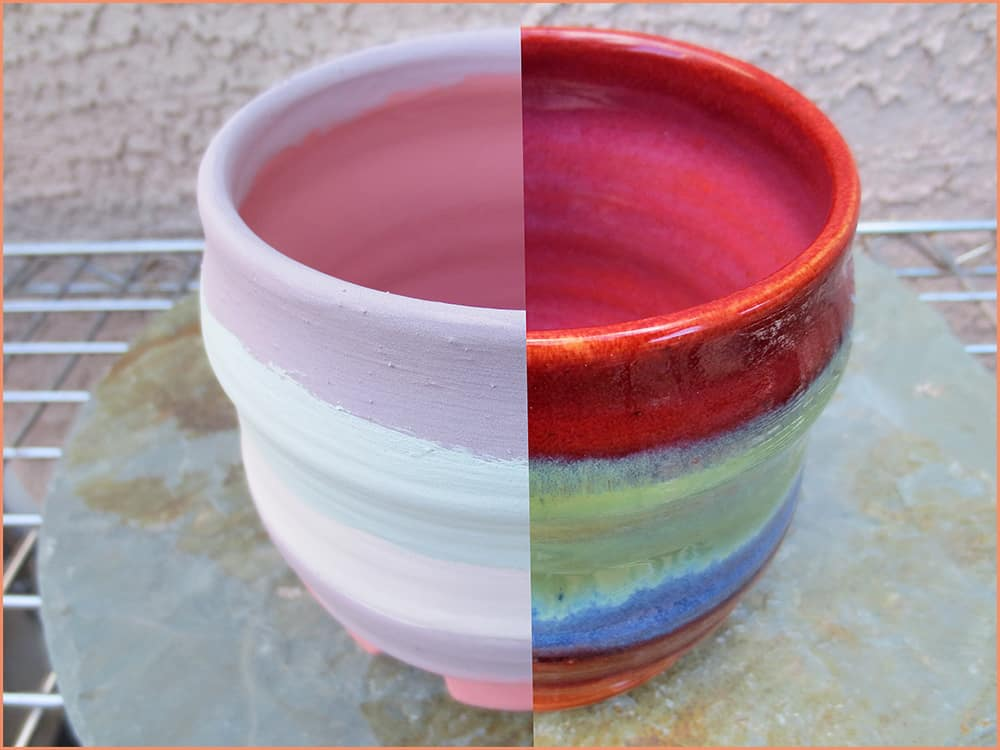
Before and after the second firing in the kiln
Often Glaze will make your work shiny.
Giving your Ceramic art a little EXTRA!
plan ahead for holes to hang your work with a wire or add beads.
Artists can be pretty brilliant. Most of the time it is very clear what we are suppose to look at in their art. It's fairly straightforward what we are to see or recognize--the focal point is usually obvious.
However some artists have been known to cleverly hide details within their work.
William Merritt Chase - Hide and Seek 1888
We recently looked at this artwork. The artist, Giuseppe Arcrimboldo, created a work that has a hidden face when the painting is rotated upside down.
Let's look at art where the artist has hidden something for us to spy in their art.
Hidden Behind Objects
Henri Rousseau never visited an actual jungle but his paintings would make you believe that he spent time in the heart of the jungle forest. Let's go for an adventure looking for tigers and monkeys hiding behind large tropical foliage.
Tiger in a Tropical Storm (Surprised!) 1891 This was Henri's first jungle painting.
The Equatorial Jungle, 1909
Looking at the painting above, it's hard to tell that Henri never left France. Henri would study images of jungles in books. He would make visits to the zoo and botanical gardens.
Two Lions on the lookout from the Jungle
The next artist, Rene' Magritte hid portraits behind objects like apples, birds and flowers. He was a surrealist and created dream-like images, things we would see in a dream and not in real life.
Man in Bowler Hat
In the painting, The Son of Man by Rene, he partly hides a face behind an apple. Renee created this self-portrait. He said, "we always want to see what is hidden by what we see."
Still You Bloom in This Land of No Gardens, 2020. Njideka Akunyili Crosby
Njideka hides figures in the middle ground behind a plant filled foreground
Hidden in Plain Sight
A a still-life of a snack may just be more than meets the eye.
Over 400 years ago Clara Peeters painted, Still Life with Cheeses, Almonds and Pretzels 1615. Dutch artist Clara Peeters was among the most talented still-life painters of her day. Pay attention to the handled jug and butter knife.
Many Dutch artists of the this time painted lavish arrangements of fancy foods, drinks and fruits usually on silver and gold plates. At first glance this still life features an array of cheeses, almonds and elegantly twisted pretzels--more common foods.
In the reflection of the ceramic goblet's pewter lid, Peeters carefully rendered her self-portrait, accurately even on the curve of the object.
And her signature appears "carved" into the silver butter knife.
The artist Jan van Eyck left us many clues in this wedding painting he made nearly 600 years ago. Jan's Arnolfini Portrait includes many details that symbolize wealth and this couples marriage.
" the small convex mirror on the wall behind the newlyweds, which shows two additional figures entering the room. The groom raises his arm in an a greeting, a gesture that is returned by one of the men in the mirror. Above the mirror it is the artists flowery signature: "Jan van Eyck was here." Even though there are many clues this painting still leaves many unsolved mysteries.
Symbolism is a way to give objects in your art a significance or represent meaning beyond what we are actually viewing in the work.
Seated in a garden of what looks to be wild roses, the 44th president of the United States is surrounded by floral symbolism meant to tell the life and history of the nation’s first African-American president.
Artist Kehinde Wiley painted each flower to relate to a portion of Obama's life. The purple African lily symbolizes his father's Kenyan heritage The white jasmine represents his Hawaiian birthplace and time spent in Indonesia The multicolored chrysanthemum signifies Chicago, the city where Obama grew up and eventually became a state senator.
Is it Really Hidden?
Colorful letters and numbers hidden in the overlapping of Jasper Johns work
Hidden Inside
Transformation Masks are worn by dancers during ceremonies but what is hiding inside?
A transformation mask, also known as an opening mask, is a type of mask used by indigenous people of the Northwest Coast the Kwakwaka'wakw (pronounced Kwak-wak-ah-wak, a Pacific Northwest Coast indigenous people) and Alaska
The outside of the mask.
Hidden inside
Worn during a potlatch, a ceremony where the host displayed his status, in part by giving away gifts to those in attendance.
These masks usually depict an outer, animal face, which the performer can open by pulling a string to reveal an inner human face carved in wood
Notice the strings used to pull the mask open
Covering Something Up
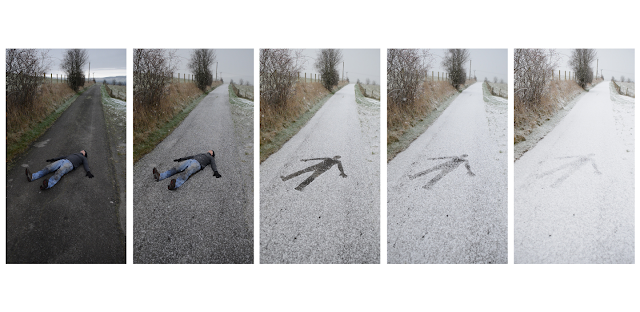
Sometimes covering something up can create a work of art like the rain shadows that Andy Goldsworthy creates by laying on dry ground and hiding the ground surface with is body while it sprinkles rain. When he stands up what is left behind is an outline.
Why might this be considered a self-portrait?
What materials does Andy use to create this work?
Does art have to last a long time?
Do you have to hide details in your art?
What would you hide if you made this artistic choice?
Take your painting to the next level. Stretch your art with the following materials. Give your painting a little EXTRA!
Glitter Paint Glitter paint is a great accent paint. It adds sparkle and shimmer to your work. Perfect for highlights and emphasis.
Check out this painting by 5th grade artist Amelia. She used traditional tempera paint first and then added glitter paint as the final layer. *Mixing glitter paint into tempera will cover the sparkle :(
Kwik Stiks If you like to draw and paint, give Kwik Stix a try. Kwik Stix are soft paint sticks that dry quickly, 90 seconds!
This is a great paint tool with the quality of drawing but covers like paint. Think of it like using detail markers or a detail brush. You are making marks and lines.
Try starting out with a sharpie drawing and filling in with color.
Kwik Stix give you control of the paint.
Try using the Kwik Stix to add texture and interest in your art. What did this artist use to create the water in this seascape?
If you are looking to paint a large area like a sky, ocean or field of grass, use liquid tempera in the egg cartons or watercolor paint and wide brush, not Kwik Stix.
Another artwork outlined with sharpie and 'painted' with Kwik Stix. Use paint and a brush or construction paper for a solid background.
*Use soft to medium Pressure. Students who do not care for the Kwik Stix and push down hard with the Kwik Stix will end their option to use this material.
Watercolor Techniques:
Crayon or Oil Pastel Resist
tape resist
Sharpie Drawing
*Visit the drawing studio and create a drawing in pencil. Outline in Sharpie.
Dry Brush
Wet on Wet
How will watercolor help you best express your idea?